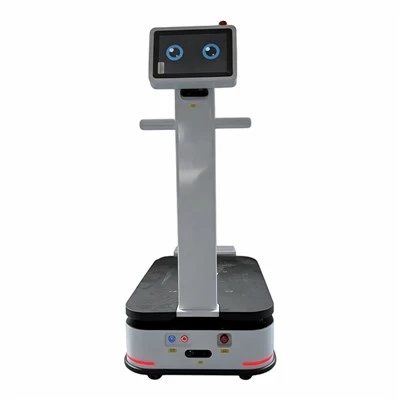
As a supplier of automatic pallet forklifts, I often encounter inquiries from customers regarding various technical aspects of our products. One question that has been coming up more frequently lately is about the data storage capacity of the control system in an automatic pallet forklift. In this blog post, I’ll delve into this topic, explaining why data storage capacity matters, exploring the factors that influence it, and sharing insights about the storage capacities typically found in our automatic pallet forklifts. Automatic Pallet Forklift
Why Data Storage Capacity Matters in Automatic Pallet Forklifts
Automatic pallet forklifts are sophisticated machines that rely on a control system to operate efficiently and safely. This control system manages a wide range of functions, from navigation and obstacle detection to load handling and communication with warehouse management systems. To perform these tasks effectively, the control system needs to store and process a significant amount of data.
One of the primary reasons for data storage is to support the forklift’s navigation system. These forklifts use sensors, such as lasers and cameras, to map their surroundings and determine the best path to reach their destination. The data collected by these sensors, including the layout of the warehouse, the location of obstacles, and the position of pallets, needs to be stored in the control system’s memory. This allows the forklift to make real – time decisions and adjust its route as needed.
Another crucial aspect is the logging of operational data. Every time the forklift performs a task, such as picking up a pallet, moving it to a different location, or interacting with other equipment in the warehouse, the control system records this information. This data can be used for various purposes, such as performance analysis, maintenance scheduling, and quality control. By analyzing the logged data, warehouse managers can identify inefficiencies in the forklift’s operation, predict potential breakdowns, and optimize the overall workflow.
Factors Influencing the Data Storage Capacity Requirements
Several factors determine how much data storage capacity an automatic pallet forklift’s control system needs. The first factor is the complexity of the warehouse environment. In a large, multi – level warehouse with a high density of pallets and a complex layout, the forklift will need to store more detailed mapping data. Additionally, if the warehouse has a high volume of traffic, with multiple forklifts and other equipment moving around, the control system will need to process and store more data related to obstacle detection and collision avoidance.
The type of tasks the forklift is expected to perform also plays a significant role. If the forklift is mainly used for simple tasks, such as moving pallets between two fixed points, the data storage requirements will be relatively low. However, if it is required to perform more complex tasks, such as sorting pallets based on different criteria or interacting with automated storage and retrieval systems, the control system will need to store and process more data.
The frequency of data updates is another important consideration. In a dynamic warehouse environment, where the layout and the position of pallets are constantly changing, the control system needs to update its stored data frequently. This means that it will require more storage capacity to accommodate the new data.
Typical Data Storage Capacities in Automatic Pallet Forklifts
In our experience as a supplier of automatic pallet forklifts, the data storage capacity of the control system can vary widely depending on the specific model and its intended application. For basic models designed for simple warehouse operations, the control system may have a storage capacity of a few gigabytes. This is usually sufficient to store the necessary mapping data, as well as a reasonable amount of operational logs.
For more advanced models, especially those used in large – scale, high – volume warehouses, the data storage capacity can range from tens to hundreds of gigabytes. These models are equipped with more powerful sensors and advanced algorithms, which generate a larger volume of data. Additionally, they often support more complex functions, such as integration with enterprise resource planning (ERP) systems and real – time data analytics, which require additional storage space.
We also offer customizable options for the data storage capacity of our automatic pallet forklifts. Depending on the customer’s specific requirements, we can install additional storage modules or upgrade the existing storage system to meet their needs. This flexibility allows us to provide the most suitable solution for each customer, whether they are running a small – scale warehouse or a large – scale distribution center.
The Future of Data Storage in Automatic Pallet Forklifts
As the technology of automatic pallet forklifts continues to evolve, the demand for larger data storage capacities is likely to increase. With the advent of artificial intelligence (AI) and machine learning (ML) in the field of warehouse automation, forklifts will be able to perform more intelligent tasks, such as self – learning and predictive maintenance. These advanced functions require the storage of a vast amount of historical data, which can be used to train the AI and ML algorithms.
In addition, the integration of the Internet of Things (IoT) in automatic pallet forklifts will also contribute to the growth of data storage requirements. IoT – enabled forklifts can communicate with other devices in the warehouse, such as sensors, robots, and conveyors, and exchange real – time data. This data needs to be stored and analyzed to optimize the overall operation of the warehouse.
Conclusion and Invitation to Connect
In conclusion, the data storage capacity of the control system in an automatic pallet forklift is a critical factor that affects its performance and functionality. As a supplier, we understand the importance of providing our customers with the right amount of storage capacity to meet their specific needs. Whether you are a small – scale business looking for a simple solution or a large – scale enterprise in need of a highly advanced system, we have the expertise and the products to support you.
Conveying Line If you are interested in learning more about our automatic pallet forklifts and their data storage capabilities, or if you would like to discuss your specific requirements and explore the possibility of a purchase, please feel free to reach out to us. We are always happy to have in – depth discussions with potential customers and provide them with the best – suited solutions for their operations.
References
- "Warehouse Automation: Technologies and Applications" by John R. Black
- "Industrial Robotics and Automation" edited by David A. Dornfeld
- "Artificial Intelligence in Logistics and Supply Chain Management" by L. Guo
Shenzhen Ginnee Intelligent Warehousing Robotics Co., Ltd.
As one of the most professional automatic pallet forklift suppliers in China, we’re featured by quality products and low price. Please rest assured to wholesale durable automatic pallet forklift in stock here and get quotation from our factory. We also accept customized orders.
Address: Room101, No.162 JunXin Road, Niuhu Community, Guanlan Strect, Longhua District, Shenzhen, Guangdong Province, China.
E-mail: huangyongmei@szginnee.com
WebSite: https://www.ginneerobotics.com/
